 Airport wildlife hazard management system
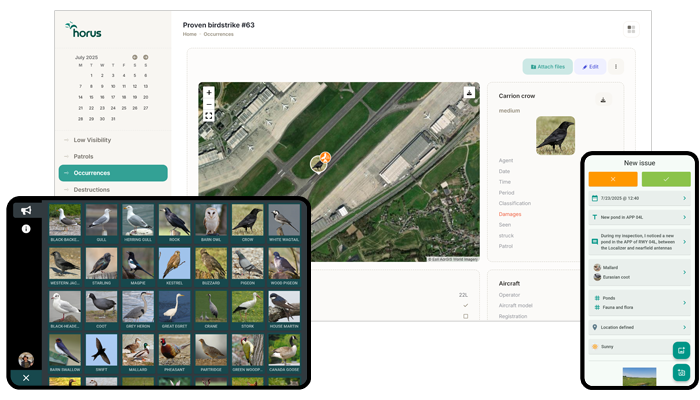
Horus is a mobile and cloud-based solution designed for wildlife hazard prevention officers (BCU) in airports. Designed with the field in mind, it facilitates the recording of actions and data processing, in compliance with ICAO and EASA standards.
Horus was born out of a simple observation: existing tools did not meet the real needs of field agents. Initially developed for Charleroi and Liège airports by a Wildlife Hazard Management Officer, Horus responds to operational constraints, emergencies, and the need for fast and reliable data entry.
Our approach: create powerful software for the men and women who use it on a daily basis.
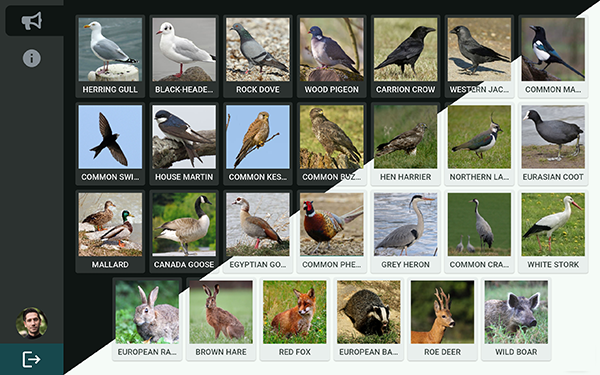
Mobile app
Web portal

Versatile
Horus is versatile and can be used for all types of missions
Keeping it simple
When everything is becoming increasingly complex, let’s keep our tools simple!
Driving on a runway is no easy task. You have to focus on driving, observing, scaring away birds, handling scaring tools, communicating with the control tower or pilots, all while under pressure from a commercial aircraft waiting to take off!
There’s no need to make it even more complicated with poorly designed interfaces full of drop-down menus and little checkboxes: the interface must be clear, easy, and intuitive.
The same applies to data analysis: sorting systems must be simple, data must be easy to access, and data presentation must be clear, with the option to export data in different formats to be used with other software such as Google Earth or QGis.
Without Horus
 Time-consuming recording
Low user engagement
Unreliable data
Useless statistics
Few export formats
Complex information transfer
Non-visual data
With Horus
 Fast recording
User satisfaction
Reliable data
Comprehensive statistics
Risk assessment
Many export formats
Email notifications
API availability
No training necessary
Features
Key features of Horus
Patrols
Observations
Scarings
Issues
Strikes
Lethal removal
Lethal removal permits
Low Visibility
Mapping
Need more?
Fixed price
Fixed annual price for controlled costs
The Horus license is an annual license with a fixed price, regardless of the number of users or connected devices.
Horus is delivered turnkey, configured and ready to use. No need to train staff to set up the system! Configuration data such as the list of animals, animal densities, scaring tools, and issue categories can be customized as needed.
Origins of Horus
The story of Horus began long before the first line of code was written! It began in 2015, on the tarmac of a Belgian airport, where I joined the Wildlife Hazard Management service after several years working as an airport security guard.
At the time, agents would go out on patrol, write down their observations on paper, and then transfer them to an Excel file once they returned to the office—sometimes one to two hours later. The data lacked precision; it was difficult to use the information, and its reliability was questionable.
In 2016, the department decided to modernize the process by adopting a solution proposed by a large French group. The system was based on an Android tablet coupled with an vehicle installed bio-acoustic bird dispersal system. But its limitations quickly became apparent: the interface was not very intuitive, the ergonomics were poor, and there was a restrictive link between encoding and sound emission. For example, it was impossible to scare away birds preventively without generating an observation entry. The solution did not meet the realities of the field. The contract was eventually canceled, and the department reverted to Excel files.
Read more ▼
In 2019, I decided to take matters into my own hands. Drawing on my dual background as a passionate developer and field agent, I began designing a software solution for our airport business in my spare time. It featured a streamlined interface, fast encoding, simplified identification, and above all, an application that could be used by all types of agents in all situations. Horus was born, and agents immediately embraced it.
In 2021, an external audit conducted at the request of a major Irish airline confirmed the relevance of Horus. Its use enables the animal hazard prevention service to meet IBSC standards, ensuring compliance with animal hazard prevention practices.
As part of a development agreement, Horus has been supplied to Charleroi Airport since 2019 and to Liège Airport since 2021. But in 2024, both airports chose, via a unified public procurement, to switch to a comprehensive airport management solution, including a wildlife hazard module. The agreement came to an end.
Faced with this situation, I decided to create my own company to market Horus. Today, the solution is mature, proven, and adaptable to all operational contexts—from the simplest to the most complex.
Our vision
Create useful, simple, and user-friendly tools
After years of using professional software in the field, one thing is clear: those who design these tools are not the ones who use them. Features, options, modules... the software is certainly sophisticated. But too often, it fails where it matters most: the user experience.
By user experience, we mean the ability to accomplish a task simply, quickly, and without friction. In the field, an action should never require more than two or three clicks. When every second counts—between a crackling radio, a moving vehicle, and an approaching aircraft—the interface must be intuitive, direct, and designed for real-world use.
Endless drop-down menus, complex lists of options, and cluttered screens all become a nightmare in an operational situation. Designing simple software is difficult. It requires confronting oneself with its use, understanding the constraints, gestures, and reflexes of end users.
We are convinced of one thing: if professional software were chosen by those who use it, rather than by purchasing departments, much of it would not survive the test of the field.
In each of our projects, we pursue a clear goal: to create useful, simple, and user-friendly tools. And we always keep this truth in mind: there is always room for improvement.
